Introduction
There is a change coming in how the world will see public transportation with the opportunity to utilize electric buses to better our planet. Due to increased fuel prices, climate change, and urban air pollution, governments are directing their focus on electric solutions to public transportation. An electric bus, or E-Bus, utilizes a battery-powered electric motor instead of a traditional diesel or petrol engine to drive the bus.
These buses are beneficial to the environment, and long term are better in costs. They also help in sustainable urban development. A lot of countries, Pakistan included, are starting to launch initiatives with electric buses to modernize their public transportation systems.
In this guide, all information pertaining to electric buses will be covered, including their operation, their advantages, the challenges they present, costs and environmental impact along with their future potential.
What Are Electric Buses?
An electric bus is a public transport vehicle that is powered by rechargable batteries instead of burned fossil fuels. Electric buses utilize stored electricity to function. Most electric vehicles operate on lithium-ion batteries.
An electric bus is made up of a few key components:
- Electric motor
- Battery pack
- Charging port
- Power control system
- Regenerative braking system
How Electric Buses Work
- Electric buses work very simply and very efficiently.
- Batteries keep the electrical energy.
- An electric motor will change the energy to mechanical power.
- There is no combustion or burning of any fuel.
When the bus is slowing down, it will use something called regenerative braking. This means that the bus will recharge the batteries while slowing down.
This system helps to keep energy waste down and helps get the most efficiency out of the bus.
Types of Electric Buses
There are different categories of electric buses:
Battery Electric Buses (BEB)
Fully powered by batteries and charged at stations.
Plug-in Hybrid Electric Buses (PHEB)
Use both electricity and fuel.
Fuel Cell Electric Buses
Powered by hydrogen fuel cells.
Battery electric buses are currently the most common type.
Benefits of Electric Buses
Environmental Benefits
- There is zero carbon emissions.
- There is less air pollution.
- There is lower greenhouse gas emissions.
Cost Saving
- There is lower cost in fuel.
- There is less bus maintenance.
- The lifespan of the vehicles are longer.
Noise Reduction
There is less noise pollution in cities because the buses are electric and operate very quietly.
Energy Efficiency
Electric motors work better than diesel engines.
Economic Impact
Electric buses will help the government by:
- Reducing fuel imports.
- Creating green jobs.
- Encouraging the building of electric vehicles.
- Attracting foreign investments.
Even through the instant cost is very high, the long term savings are very high as well.
Charging Infrastructure
Electric buses require:
- Depot charging stations
- Fast-charging terminals
- Battery management systems
- Stable electricity supply
Expanding charging infrastructure is essential for large-scale adoption.
Challenges of Electric Buses
Electric vehicles (EVs), although progressively beneficial, still bring their users notable inconveniences, such as:
- The high cost of purchase
- The high cost (both initial and repeated) of battery replacement (since the batteries do not last as long as the vehicles’ other parts)
- Long wait times to charge
- Limited number of (and often inconveniently located) charging stations
Nonetheless, the advancements being made in battery technology are addressing these concerns; therefore, the limitations of the above concerns will be increasingly reduced in the future.
Environmental Impact of Electric Buses
Electric buses play a vital role in minimizing:
- Urban smog
- Respiratory illnesses
- Carbon Footprint
They assist in reducing the negative impacts of climate change and contribute to providing a clean and healthy environment.
Electric Buses in Pakistan
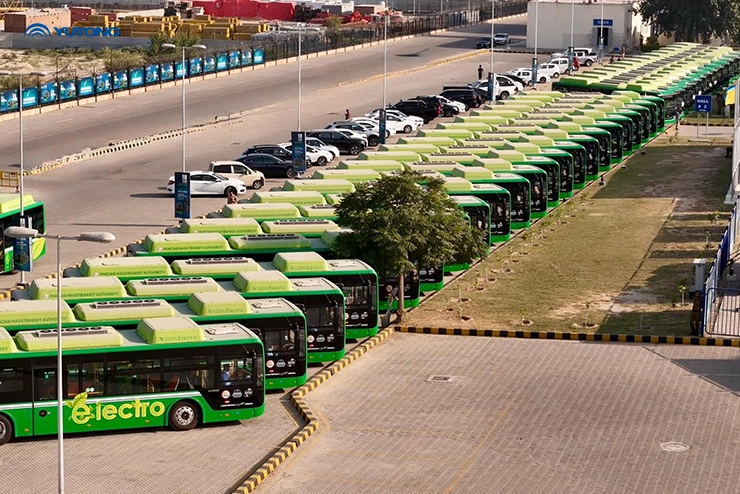
To help ease the problems of modern public transport, as well as urban pollution, and to help improve the smart use of urban mobility, eco-friendly public transport solutions are being made available in Pakistan by the introduction of electric bus projects in the major cities of the country .
Future of Electric Buses
The future of public transport electric buses is bright as a result of the following:
- Government support
- Technological advancements in electric vehicles (EVs)
- Decline in battery costs
- Commitments towards climate change made globally
In the coming decades, there will be a major change towards electric public transport as anticipated by experts.
FAQs
What are electric buses?
Electric buses are vehicles powered by rechargeable batteries instead of fuel.
Are electric buses environmentally friendly?
Yes, they produce zero tailpipe emissions.
Are electric buses expensive?
Initial costs are high, but long-term savings are substantial.
How long do electric bus batteries last?
Battery life typically ranges from 6 to 10 years.
Do electric buses reduce pollution?
Yes, they significantly lower air and noise pollution.
Conclusion
Electric buses represent the future of sustainable public transportation. They offer environmental benefits, economic savings, and improved urban mobility. While challenges exist, technological advancements and government support are accelerating adoption worldwide.
As cities continue to expand, electric buses will play a crucial role in building cleaner, smarter, and greener transportation systems.
The government of Pakistan also start the e bike scheme.